
Use SHARA in a Zoom meeting
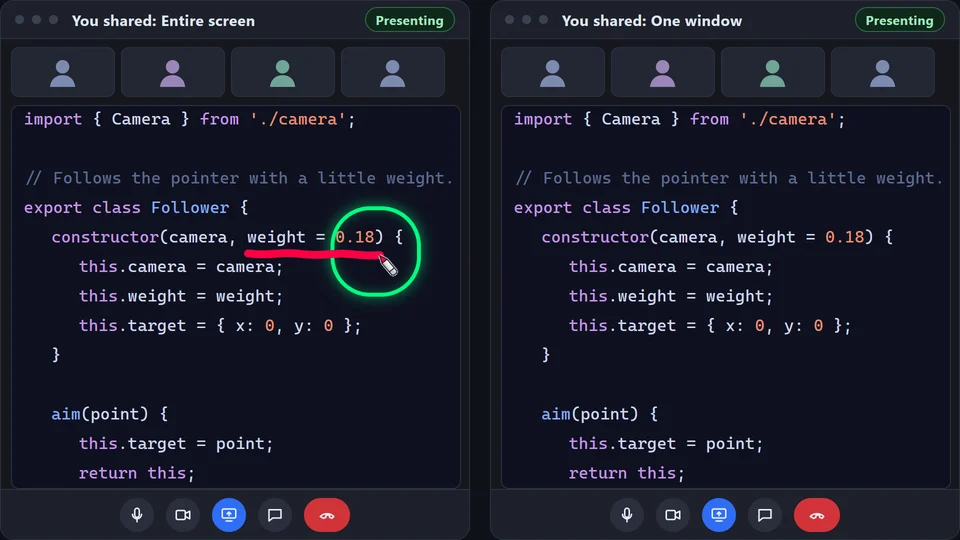
To show SHARA in Zoom, click Share, open the Screens tab and choose your entire screen, not one application window. SHARA draws on its own layer above your apps, so Zoom sends your cursor halo and your ink to everyone, and no host permission or Annotate setting is involved. The halo and the basic draw tools are free.
Quick path
- In Zoom click Share, open the Screens tab and choose your entire screen, not a window.
- Hold Ctrl+Space, move into Draw, pick Pen or Laser, and draw.
Viewers see the halo and the ink. - Before the call: switch Tips off and decide whether viewers should see the Wheel.
Share your entire screen#
Do this once per meeting, before you draw. The one choice that matters is your whole screen, not an application window.
- Start SHARA before you share.The halo follows your pointer as soon as SHARA is running, so it is already on screen when the share begins.
- In Zoom’s meeting controls, click Share.The Share window opens. Zoom’s labels can differ a little between versions.
- Open the Screens tab and select your entire screen.Zoom describes the Screens tab as the place to share “your entire screen or specific application windows”. Pick the screen. An application window sends that one window, and SHARA’s layer is a separate window that is not part of it. With more than one monitor, pick the one you will draw on.
- Leave Optimize for video sharing off.Zoom says that option is for full-screen video clips and can blur other shared content, such as a slide or an editor. Switch it on only when you play a video.
- Click Share.Your meeting controls turn into a floating toolbar you can drag, with Stop share on it. If Zoom’s Show green border around my shared content option is on (Zoom Settings, Share screen), a green frame also marks the screen you shared.
Zoom’s own steps: Sharing your screen or desktop on Zoom.
Draw in the meeting#
The Wheel is your menu. Hold the keys, move, let go, and the tool is in your hand.
- Hold Ctrl+Space.The Wheel opens at your pointer (Ctrl+Alt+Space if a Chinese input language is installed).
- Move into the Draw slice, then out to Laser or Pen, and let go.The hub reads Draw while you are on the slice. Laser fades 2.6 seconds after you draw it. Pen stays until you clear it.
- Rest on the thing you mean, then drag a short line under it.The halo keeps your pointer easy to find while you rest on the line you are explaining. A short mark is complete the moment it is drawn, so it reads under whatever frame rate Zoom sends. What you draw is on the screen Zoom is sending.
- Take it back: Ctrl+Z undoes the last mark, Ctrl+Win+B clears them all.Press Esc or right-click to put the tool down. Your ink stays until you clear it.
More on the Wheel and the docked toolbar: Wheel and toolbar. Every draw tool is on Draw tools.
Before you go live#
Six checks that stop SHARA’s own prompts, Zoom’s controls or an idle halo getting in the way of a meeting.
- Switch Tips off for the call.Settings, System tab, General card, the Tips switch (“Hints and reminders SHARA shows by itself”). SHARA does not detect a Zoom share, so a first-use hint can appear on a screen the meeting is watching. The hint shows once per tool, so using each tool one time before the call also clears it.
- Ctrl+Space is free in Zoom.Zoom’s Windows shortcut list has no Ctrl+Space and no Windows-key chords, and its share shortcuts (Alt+S, Alt+Shift+S, Alt+T) work only while Zoom’s meeting controls have focus. One thing to test: Zoom’s push-to-talk (Settings, Audio) unmutes you on the Space key while the Zoom window is in front. While you share, the shared app is in front; if you open the Wheel from the Zoom window itself, check that you do not unmute by accident. Zoom’s own keys are on the Zoom shortcuts sheet, and SHARA’s chords can move: Change hotkeys.
- Decide whether viewers should see the Wheel.By default they do. The Wheel shows only while you hold the keys; the docked toolbar stays on screen, so it matters more. To keep both out of the share while your ink stays in: Settings, Tutor tab, Wheel display settings, Recording, Hidden. It is a request to Windows, so test it with one person first: hide from capture has the steps and the test. Zoom’s own toolbar is separate: Zoom’s Settings, Share screen has Include sharing toolbar, annotation toolbar, and meeting notifications, and it decides whether viewers see Zoom’s controls.
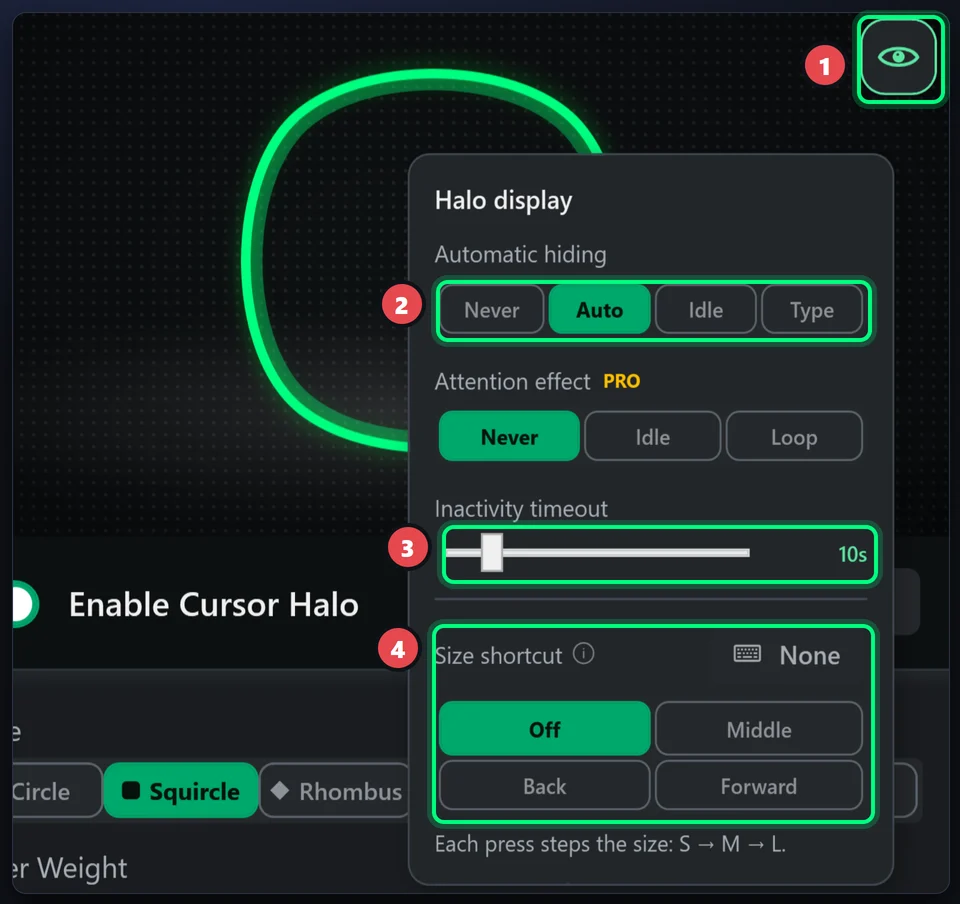
- Keep the halo on when you stop moving.The halo hides itself after 10 seconds without pointer movement (Automatic hiding: Auto) and comes back as soon as you move. To keep the marker on screen while you talk, set Never (Appearance tab, the eye button on the preview).
- Move Zoom’s floating toolbar out of the way.You can drag it. SHARA’s toolbar docks to the nearest edge where you drop it, and starts on the left edge, so keep the two apart and your pen never ends up under either.
- Test with one person.Share, draw one stroke and ask them what they see. Or use the screen share test.
SHARA or Zoom Annotate#
Zoom has its own drawing tools. They do different jobs, and you can use both. Zoom’s lets viewers draw too; SHARA never needs a setting.
| Question | Zoom Annotate | SHARA |
|---|---|---|
| Who can draw | You and, when annotation is allowed, the viewers. As the sharer you can allow or block others under More; the host can switch it off for them too. | Only you. It is your own screen. |
| What can switch it off | An account, group or user setting in Zoom’s web portal, which an admin can lock. If the toggle is grey, it is locked above you. | Nothing in Zoom. SHARA is a Windows overlay, not a Zoom feature. |
| A mark that fades | Vanishing pen (sharer only): fades “within a couple of seconds”. | Laser: fades 2.6 seconds after you draw it, fixed. Pen stays until you clear it. |
| Where you start it | The Annotate button on the share controls; the tools usually appear on their own when you share. | Ctrl+Space from any app, or SHARA’s docked toolbar. |
| Pointing | Spotlight (sharer only) shows your pointer to all participants inside the shared area. Arrow shows a small arrow with your name. | The halo follows your pointer all the time, and hides after 10 idle seconds unless you set Never. |
| Saving | Save writes the shared screen with its annotations to a PNG or PDF. | Screenshots with your ink. |
| Needs | Built into Zoom. | SHARA installed on your PC and an entire-screen share. The halo, Laser, Pen, Arrow, Text and Eraser are free. |
Zoom facts from Zoom Support, read November 10, 2026: Using annotation tools on a shared screen or whiteboard, and Enabling or disabling annotation tools for meetings.
Several monitors#
Pick the screen you will draw on in Zoom’s Share window. Zoom’s sharing page does not describe a monitor step, so check the picture before you click Share, and turn on Zoom’s green border if you want a frame around the screen you shared. SHARA’s drawing layer covers all your monitors, so you can draw on whichever one you shared. Mixed-DPI and ultrawide set-ups are on multiple monitors and 4K.
What Zoom cannot show#
- An application window. A window share carries that window only: no halo, no ink.
- The Documents tab. It shares a Whiteboard, a Zoom Docs file or a file from another service as content, rather than your screen. Our reading is that SHARA’s layer is not in that picture; we have not tested it. Share your screen with the file open instead.
- Portion of screen. The Advanced tab can share one rectangle, marked by a green frame. SHARA’s layer is part of the screen, so draw inside the frame; we have not tested it.
- The Wheel and the toolbar. Visible to viewers unless you hide them: hide from capture.
If it doesn’t work#
If viewers don’t see it
- They see your slides but no ink or halo. You probably shared an application window. Click Stop share, click Share again and choose your screen on the Screens tab. Why a window share misses it.
- You shared the other monitor. Draw on the monitor you shared, or share the one you draw on.
- Nothing opens when you hold Ctrl+Space. SHARA may be off (Ctrl+Win+Z turns it on and off), or the chord is taken: Change hotkeys.
- Viewers see your Wheel and toolbar. That is the default. Hide them from capture.
- The pointer looks jumpy to viewers. Zoom’s Share screen Advanced settings include Limit your screen share to ___ frames-per-second; a low number caps how smoothly anything moves. Check it is off or set higher. The halo and short marks help a choppy share, they do not change the rate.
- Zoom’s own advice when viewers can’t see your screen: in the same Advanced settings, under Enable hardware acceleration for, clear Screen sharing. We have not tested whether it changes how SHARA’s layer is captured; it is Zoom’s step for a share that does not show up.
- Still stuck. Email info@sharacursor.com with your Windows version (press Win+R, type
winver), what you picked on Zoom’s Screens tab, and what viewers see.
Little details worth knowing#
- SHARA has no Zoom add-inIt draws on your screen and Zoom sends that screen. Viewers install nothing, and no Zoom setting is involved.
- Zoom is not detectedSHARA recognises a PowerPoint slide show or a cloned display, not a Zoom, Teams or OBS share. So its own hints and balloons are not held back during a Zoom share: switch Tips off or use each tool once beforehand.
- Two green thingsZoom’s green border frames the whole shared screen (if you turned it on). SHARA’s green ring follows your pointer. They are different.
- The Wheel hides when you let goThe Wheel closes 100 ms after you release the chord, and your pick stays in hand until Esc or a right-click.
- One drawing layer for all monitorsSHARA’s layer spans the whole virtual screen, so you can draw on whichever monitor you shared.
- Laser is 2.6 seconds, fixedThe Laser trail fades 2.6 seconds after you draw it.
There is no setting for it. - Undo has a ruleCtrl+Z undoes the last mark right after you draw it. If you click elsewhere first, the key goes to the app you clicked.
Questions#
Do I need the host to turn on annotation for SHARA?
Zoom’s Annotate is greyed out. Do I have to fix that to draw?
Can viewers draw with SHARA?
Will viewers see the Wheel and the toolbar?
Does Ctrl+Space clash with Zoom?
Is SHARA free to use in Zoom?
Does it work in Zoom in a browser?
I shared my screen and viewers still don’t see my drawing. What now?
Related
Other call apps: Teams, Google Meet, Discord and OBS. The SHARA FAQ has the short answers.
More in Works with: SHARA with PowerPoint · SHARA with Discord · SHARA with Google Meet.